
A screenshot used to be a receipt. Not perfect proof, but close enough for everyday life. You could crop it, sure. You could omit context. But the basic social contract held: this image was taken from a real screen, at a real moment, and it showed something that happened.
That contract is fraying. Not because people suddenly became dishonest, but because it has become effortless to manufacture the look of honesty.
The new “found footage” of the internet
Fake chat screenshots sit in a strange category of modern media. They are not deepfakes in the cinematic sense. They are closer to found footage, the grainy camcorder aesthetic that made horror films feel plausible. A message thread, with familiar bubbles and timestamps, feels like reality. It feels private. It feels like you were never supposed to see it, which is exactly why it circulates.
And now anyone can generate that effect in minutes. A tool like a fake messenger screenshot can mock up conversations for WhatsApp, Instagram, Discord, iMessage, Telegram, Messenger, X, Slack, Signal, TikTok, Snapchat, LINE, Microsoft Teams, Tinder, Bumble, and OnlyFans. The variety matters. If the fake only worked for one app, we would learn to be suspicious. But when the template matches whichever platform your group chat lives on, skepticism has to fight nostalgia, habit, and recognition.
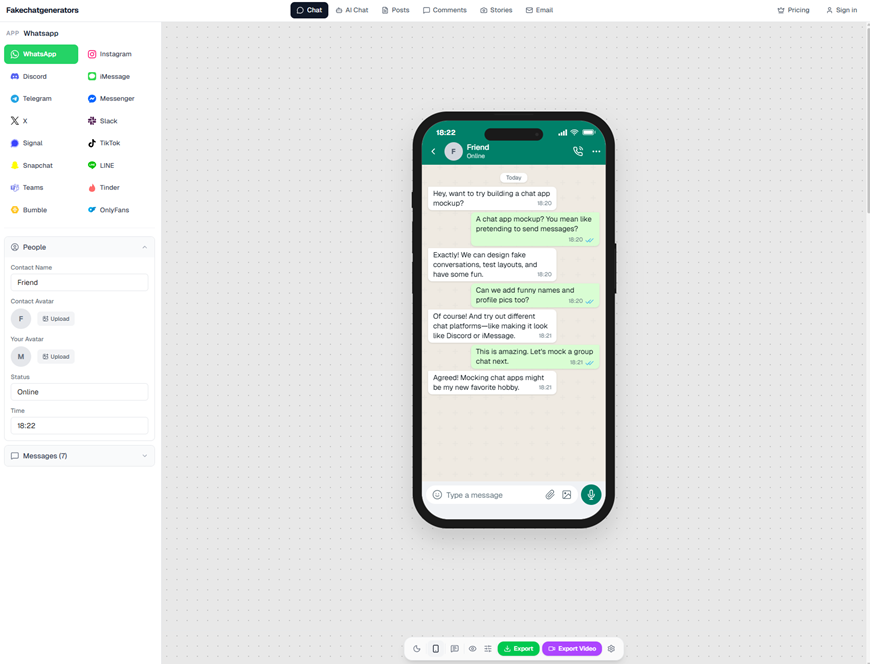
fakechatgenerators.com lets you mock up chat screenshots across 16 platforms
It is not hard to see why these generators are popular. They are used for memes, prank screenshots, film and TV production mockups, UX wireframes, classroom examples, storyboarding, and social media skits. In those contexts, the fakery is often part of the joke or the craft, no more sinister than a prop newspaper in a movie.
The ethical trouble begins when the prop escapes the set.
When “just a meme” stops being harmless
Memes are frequently defended as unserious by design. That defense is sometimes fair. A screenshot of a celebrity “texting” their mom about an absurd craving is obviously a joke, and it stays that way because it is framed as comedy and spread among people fluent in the format.
But the same visual language can also be used to borrow credibility. A screenshot can imply: this is how they talk when the camera is off, this is what they really believe, this is what they admitted. It invites a kind of voyeuristic trust.
If you are a marketer, you have seen the temptation. Fake “DMs” are a tidy way to dramatize a testimonial. A screenshot can stage the moment a customer “can’t believe the results,” or the moment a founder “humbly” replies, or the playful banter between brand and buyer. It looks like social proof without the messy work of collecting it. It can also be designed to feel casual, which is exactly what standard ad copy is not.
Even when the intent is comedic, the technique can slide into manipulation. A skit account might post a fake chat that “could happen” between roommates, coworkers, or couples, and the audience is meant to enjoy the relatability. Fine. But if the same account starts using the format to imply real brand partnerships, real receipts, real conflict with real people, the line becomes less a boundary and more a suggestion.
And once the format is normalized, bad actors do not need to invent new tricks. They can simply borrow ours.
The screenshot is a weapon because it is familiar
A forged chat is effective for the same reason a forged letterhead is effective: it comes preloaded with authority. The app UI does some of the persuading. Time stamps. Delivery checks. A profile picture. The particular shade of green or blue. These tiny design decisions, made by product teams to feel friendly, become tools for credibility laundering.
There is also the intimacy factor. A public statement can be debated. A private message feels like a confession. It carries a whisper of “behind closed doors,” which makes people drop their guard. That is why fabricated screenshots can damage reputations quickly, especially in smaller communities where people know each other by name and a rumor spreads faster than a correction.
And unlike a manipulated video, a fake chat is low-bandwidth. It can be posted, screenshotted again, cropped, and reposted across platforms without losing its punch. It is portable, easy to translate, easy to modify, easy to weaponize.
Detection tools are necessary, and still not enough
In response, a new industry has formed around verification. Services like an AI image detection tool promise to spot AI-generated media, NSFW content, violence, and document tampering. Sightova, for example, claims 98.7% detection accuracy across 50+ generative models, including Midjourney, DALL-E, Stable Diffusion, Flux, Ideogram, Google Gemini, and GANs, with sub-150ms latency. Those numbers are impressive, and for journalists, moderation teams, banks, marketplaces, and legal departments, speed matters. If you are triaging thousands of uploads a minute, you need something fast.
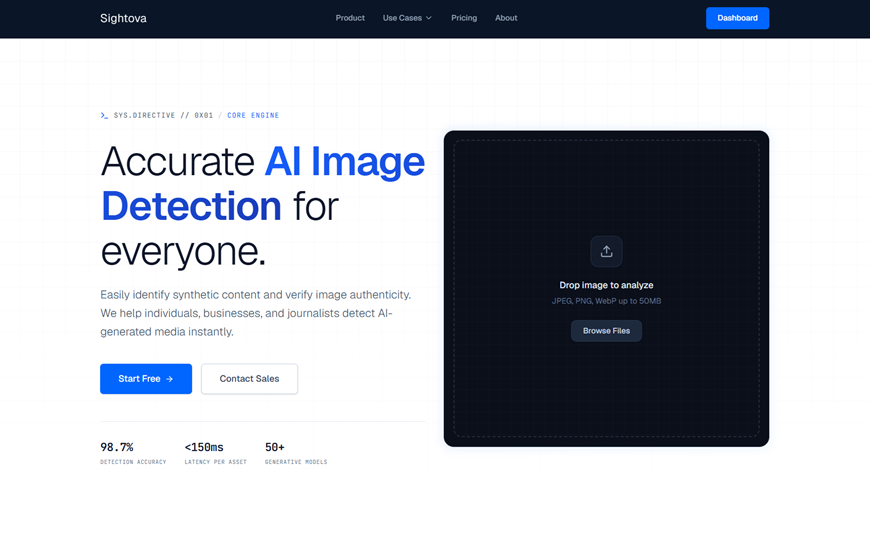
sightova.com flags AI-generated, tampered, NSFW, and violent imagery in milliseconds
But here is the uncomfortable truth: even excellent detection does not fully solve the ethical problem of fake messenger screenshots, because the problem is not only technical. It is cultural.
A lot of fake chat screenshots are not even “AI-generated” in the flashy sense. They are typed by a human into a template. The pixels may be pristine. The lies are analog. Detection can help when an image has artifacts or when a document has been tampered with, but it cannot, by itself, restore the social contract that screenshots once carried.
We are going to need norms again. Not the kind that make people feel policed, but the kind that make deception less profitable.
Marketing’s quiet role in normalizing fakery
Marketers love formats that travel. We inherit what works, then we optimize. The fake chat screenshot is catnip for that mindset because it compresses a narrative into a single frame and looks “native” to the feed. It can be persuasive in a way that feels like entertainment, which is a polite way of saying it can sneak past a person’s defenses.
If you have ever sat in a content brainstorm where someone said, “What if we show the DMs?” you know how quickly ethics can become an afterthought. The pressure is not always malicious. It can be simple competitiveness. If a rival brand is staging friendly customer messages and getting engagement, your team will wonder whether you are being naive by refusing.
But if brands normalize simulated authenticity, they also normalize the idea that message receipts are just another creative asset. That is a gift to scammers. It trains audiences to accept a screenshot as narrative, not evidence.
And when that training is widespread, the fallout is not evenly distributed. People with less power, less media literacy, or less access to legal recourse take the hit. A small creator can be dragged by a forged chat. A teenager can be targeted. An employee can be “proved” disloyal with a screenshot that never existed. The internet has always had mob energy, but fake receipts pour gasoline.
A simple ethical test: could this harm someone who didn’t opt in?
One way to cut through the fog is to ask a blunt question before posting or publishing: could this believable fake harm someone who did not consent to being part of the story?
In film production mockups, classroom examples, UX wireframes, and storyboards, the answer is usually no, because the work is private or clearly fictionalized. In memes, the answer is often “probably not,” but that depends on how it is framed and whether it uses a real person’s name, face, handle, or likeness.
In content marketing, the answer gets complicated. If a brand posts a staged DM thread without disclosure, the harm might not be immediate, but it contributes to an environment where fabricated evidence is normal. That is a slow harm, the kind you only notice once trust is already gone.
If the “DMs” include a real customer’s name, even with permission, you still have a responsibility to avoid implying that the customer said something they did not. Consent is not a blanket moral waiver. People agree to things they do not fully understand all the time, especially when a brand is dangling a discount, attention, or status.
And if the fake chat depicts a competitor, a critic, an ex-employee, or a vague “hater,” it is not a joke anymore. It is a strategy.
Disclosure is not a cure-all, but it is the minimum
Some will argue that disclosure ruins the bit. Sometimes it does. But that is a clue. If the content only “works” when it borrows the authority of a real receipt, then the content’s power comes from deception, not creativity.
Clear labels like “skit,” “parody,” or “mockup” do not solve every downstream misuse, because screenshots get stripped of context as they travel. Still, disclosure is the minimum ethical posture, particularly for brands. If you have money behind the message, you should not also have plausible deniability.
There is also a design choice here: make the fake obviously fake. Add impossible timestamps. Use nonsense names. Avoid copying a real person’s avatar. Steer away from exact UI fidelity if the goal is humor. A prop can look like a prop.
This is not about being precious. It is about not building weapons you would hate to see used against you.
What we should teach, and what we should stop rewarding
The most durable defense against fake receipts is a public that slows down. That is a tall order, because outrage is fast and feeds are built for speed. But media literacy can be taught as habit, not just information.
A few practical norms are worth repeating until they feel boring:
- Treat screenshots as claims, not proof.
- Ask for context: what came before, what came after?
- Look for corroboration, especially if reputations are at stake.
- Be cautious with “private” messages presented in public for maximum impact.
- Notice who benefits from you believing it right now.
At the same time, we should stop rewarding the aesthetics of authenticity when they are divorced from reality. If a brand’s most effective ad format is “look at this private message,” we should ask why. If a creator’s biggest growth lever is “exposing” someone through a screenshot, we should ask what kind of internet we are building.
A closing thought: the point is not to ban the tool
It is tempting, whenever a new form of fakery spreads, to focus on the generator itself. But the tool is not the whole story. People will always have ways to fabricate. The deeper issue is what we celebrate, what we share, and what we treat as “good enough” evidence when emotions are high.
Fake chat generators can be useful. They can be funny. They can help production teams plan scenes and teachers explain concepts. They can even help marketers storyboard customer journeys without putting real users on display.
But we should be honest about the trade we are making. Every time we let a forged receipt pass as entertainment, or as “relatable content,” we make it easier for someone else to pass a forged receipt as reality. And when trust becomes optional, the internet does not get more playful. It gets colder.